Is Internet Calling Worth It in Switzerland?



Making phone calls over the internet is no longer a technology of the future. In fact, most households in Switzerland already use VoIP (Voice over Internet Protocol) without even realising it. That’s because traditional landline connections now operate over the internet in most cases.
The real question, therefore, is not whether VoIP is a smart or practical technology, but what added value a dedicated VoIP service offers compared with a conventional landline connection. In this guide, you’ll learn how internet calling works, the differences between a standard landline subscription and a standalone VoIP service, and who can truly benefit from using one.







What Is VoIP? Internet Calling Explained
If you’re wondering what VoIP is, the simple answer is that it is a technology that enables telephone calls to be transmitted as digital data over the internet. VoIP stands for Voice over Internet Protocol. Instead of using a traditional telephone line, your voice is converted into small digital data packets and transmitted via an internet connection.
This form of internet telephony allows you to make and receive calls from almost anywhere, provided you have a stable internet connection. For users, making a VoIP call feels no different from a regular phone conversation. You can even use a traditional desk phone with VoIP. Behind the scenes, the technology acts like a virtual telephone system, transmitting voice data digitally via IP.
| Term | Meaning |
| VoIP | Voice transmission over the internet |
| SIP (Session Initiation Protocol) | Standard protocol used to establish VoIP connections |
| Internet telephony | Making phone calls via an internet connection |
| Softphone | Software or an app for making calls on a computer or smartphone |
Today, VoIP technology is widely used by both private individuals and businesses, forming the foundation of modern telephony.
Important to Know: Switzerland’s Landline Network Already Runs on VoIP

Many people assume that landline telephony and VoIP are two completely different systems. In reality, Swisscom completed the migration from analogue and ISDN connections to an all-IP network between 2017 and 2018. Today, virtually all modern landline services in Switzerland operate via the internet.
This means that if you currently have a residential landline, you’re already using VoIP technology—even if you’re not aware of it. Your router automatically converts your voice into digital data packets and connects to your provider’s network.
For most users, this entire process takes place in the background, which is why no additional hardware is usually required.
| Then | Now |
| Analogue telephone line | All-IP internet connection |
| Analogue or ISDN telephone | VoIP technology |
| Dedicated telephone line | Router manages the connection |
VoIP vs Landline: What’s the Difference?
The comparison between VoIP and a traditional landline often causes confusion. Technically, both now rely on the same underlying technology. The real difference lies in how the service is provided.
A conventional landline subscription is fully managed by your telecommunications provider. You receive a telephone number, connect your phone to the router, and hardly need to worry about the setup. Your provider takes care of the configuration, maintenance and technical support.
A standalone VoIP service, on the other hand, offers significantly greater flexibility. You register with a dedicated VoIP provider, configure your own account settings and can often use your telephone service on several devices simultaneously. Many providers also offer additional features such as multiple telephone numbers, call forwarding and cloud integration.
| Landline Subscription | Standalone VoIP Service |
| Set up by the provider | Self-configuration |
| Telephone connected to the router | Softphone app or SIP phone |
| Limited configuration options | Wide range of custom features |
| Usually included with an internet package | Often available as a separate service |
Standalone VoIP solutions are particularly attractive for businesses and self-employed professionals, as they provide greater flexibility than a traditional landline subscription.
How Does VoIP Calling Work in Practice?
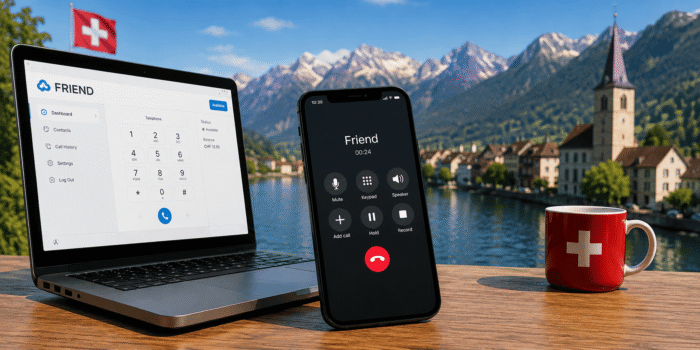
In everyday use, there are two common ways to make VoIP calls:
- Use an app on your computer or smartphone (a softphone).
- Use a dedicated SIP-compatible telephone connected directly to your router.
Both options require a reliable internet connection to ensure clear, uninterrupted calls. Most modern routers already support VoIP technology, making the setup process quick and straightforward.
The best solution depends on your needs. If you frequently make calls while travelling, a softphone offers maximum flexibility. If you prefer a permanent workstation with professional equipment, a SIP desk phone may be the better choice.
VoIP via Apps and Softphones
A softphone is an application for Windows, Android or iPhone that allows you to make calls directly over your internet connection. No additional hardware is required.
Once you’ve registered with your chosen provider, you can make and receive calls using your own telephone number—whether you’re at home, in the office or on the move.
VoIP via SIP Phones
Alternatively, you can connect a SIP-compatible telephone directly to your router. Although this solution resembles a traditional desk phone, it also uses the internet to transmit calls.
It is particularly suitable for users who prefer a fixed workstation or regularly make professional business calls. After the initial configuration, a SIP phone works much like a conventional telephone.
Advantages and Disadvantages of VoIP in Switzerland
VoIP offers many advantages, but there are also a few factors worth considering. Whether it’s the right solution for you largely depends on how often you make calls, which features you need and how important flexibility is to your daily communication.
A modern VoIP service is particularly useful if you want to use your telephone service independently of your location. However, a stable internet connection remains essential to ensure consistently high call quality.
Key Advantages and Disadvantages at a Glance
- Greater flexibility: Use your telephone service across multiple devices without being tied to a single location.
- Lower costs: International calls are often significantly cheaper than with traditional telephone services.
- Advanced features: Easily manage call forwarding, voicemail and multiple devices.
- Easy scalability: Businesses can quickly add new users and telephone numbers.
- Internet dependency: Calls cannot be made if your internet connection or power supply fails.
- Connection quality: Poor internet performance may affect voice quality.
| Advantage | Explanation |
| Location independence | Make calls wherever you have an internet connection. |
| Cost-effective | Particularly beneficial for international calls. |
| Advanced features | Call forwarding, cloud integration and multiple phone lines. |
| Flexible use | Switch seamlessly between apps, desk phones and computers. |
Benefits of VoIP
One of the greatest advantages of VoIP is its flexibility. You can use your telephone number regardless of your location, allowing you to make and receive calls from home, the office or while travelling. Many providers also offer useful features such as automatic call forwarding, digital voicemail and the ability to connect multiple devices to the same account.
VoIP can also help reduce communication costs. International calls are often considerably cheaper than with traditional telephone services, and many providers offer competitively priced calling packages. For businesses, VoIP also provides advanced features that improve internal and external communication.
The Drawbacks of VoIP: A Reliable Internet Connection Is Essential
Despite its many advantages, VoIP does have some limitations. The technology relies entirely on a stable internet connection. If your internet service is interrupted, you will generally be unable to make or receive calls. Similarly, poor connection quality can lead to delays, dropped calls or reduced voice quality.
Power outages are another consideration. Unlike older analogue telephone lines, which could often continue operating during a power cut, modern routers and VoIP devices require electricity. Without backup power, your telephone service may become unavailable during prolonged outages.
Choosing a VoIP Provider in Switzerland: What Should You Look For?

If you’re considering a dedicated VoIP provider, it’s worth comparing the available options carefully. Not every provider offers the same features, pricing or level of service. Key factors include reliable call quality, transparent subscription costs and an easy setup process.
Before making your decision, consider the following:
- Call quality: Choose a provider with a reliable and stable network infrastructure.
- Pricing: Compare monthly subscription fees as well as charges for national and international calls.
- Features: Consider whether you need extras such as call forwarding, multiple users or cloud integration.
- Compatibility: Ensure your existing router or SIP telephone is supported.
- Customer support: Responsive technical support can be invaluable during setup and troubleshooting.
Some users prefer to continue using their existing hardware, while others favour a fully cloud-based solution. A good VoIP provider should support both approaches.
| Criterion | Why It Matters |
| Price | Helps avoid unnecessary ongoing costs |
| Features | Important for both private and business users |
| Hardware compatibility | Essential if you want to keep using existing telephones |
| Customer support | Provides assistance with setup and technical issues |
Conclusion: Is VoIP Worth It?
Most people in Switzerland already use VoIP technology without even realising it. Today’s landline services are almost entirely based on internet telephony. As a result, a standalone VoIP service is primarily beneficial for users who require greater flexibility, advanced features or a more professional communication solution.
If you simply want a home telephone, your existing landline service will usually provide everything you need. However, if you want to work from different locations, connect multiple devices or manage your telephone system more efficiently, a dedicated VoIP solution could be an excellent investment.
Frequently Asked Questions
Yes, landline services are still available. However, the underlying technology is now typically based on VoIP, or All-IP. Traditional analogue telephone lines have largely been phased out and replaced by modern internet-based technology.
Not necessarily. You can use VoIP through an app on your smartphone or computer. Alternatively, if you prefer a traditional telephone experience, you can connect a SIP-compatible desk phone to your router and configure it accordingly.
That depends on your equipment. Because routers and VoIP devices require electricity, your telephone service will usually stop working during a power outage. A backup power supply can help maintain service for a limited period.
It depends on how you use your telephone service. Many VoIP providers offer competitive pricing, particularly for international calls. However, if you only make occasional calls, your existing internet or mobile package may already include everything you need.
VoIP uses modern encryption and security technologies, but like any digital communication system, it is not completely immune to potential risks. Choosing a reputable provider, using strong login credentials, keeping your devices up to date and installing regular software updates will all help protect your conversations.