Internet + TV in One Package: What Is Really Affordable and What Isn’t


Combining an internet and TV subscription sounds like the simplest solution at first: one provider, one bill, and a complete package for your home. However, not every offer that appears affordable is actually good value for money. Many internet and TV bundles advertise low introductory prices. Later on, however, higher monthly costs or additional fees may apply.
In this guide, we explain what really matters when comparing offers. You will learn:
- which services are included
- which cost traps you should avoid
- how to find the right internet and TV subscription for your needs.
This will help you compare offers more effectively and make a decision that is genuinely affordable in the long term.







Why an Internet and TV Bundle Makes Sense for Many Households
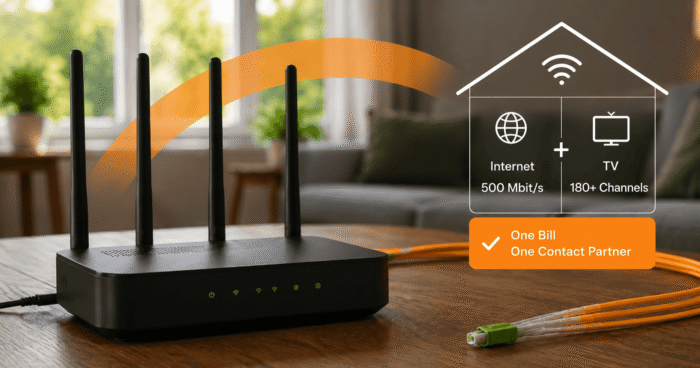
An internet and TV bundle primarily offers convenience. Instead of managing two different contracts with different providers, you get everything from a single source. One bill, one point of contact, and often a lower overall price are the main advantages.
Many households choose a combined package because they need an internet connection anyway and also want to watch films and series via a digital service. By combining services, providers can offer attractive discounts.
Nevertheless, comparing bundles is worthwhile, because not every package is suitable for every household. The key factors are not only the price, but also speed, TV features, and contract terms.
What Is Normally Included in an Internet and TV Package?
A bundle basically consists of two components: an internet connection and a TV service. Depending on the provider, additional services such as landline telephone service, a TV app, or streaming integration may also be included.
The main differences are in internet speed and the scope of the TV offering.
Internet Speed: How Much Bandwidth Do You Really Need?
The right internet speed mainly depends on two factors:
- How many people use the internet?
- What is the internet used for?
Many users pay for high maximum speeds even though they do not actually need them.
For simple tasks such as browsing, emails, and occasional streaming, 50 to 100 Mbps is often sufficient. Households with several people are more likely to benefit from 200 to 500 Mbps. Anyone who frequently streams in 4K, enjoys online gaming, or processes large files while working from home should choose higher bandwidth.
| Usage | Recommended Speed |
| Browsing, emails, social media | From 100 Mbps |
| HD streaming, small households | 100–200 Mbps |
| Multiple users, 4K streaming | From 500 Mbps |
| Gaming, working from home, video conferencing, many devices | 500 Mbps to 10 Gbps |
A higher speed does not automatically provide a better experience if your Wi-Fi or router is the limiting factor. Therefore, always consider the internet connection as a whole.
TV Features at a Glance: Channels, Replay and Streaming Apps for the Best Entertainment Experience
There are also major differences between TV packages. An affordable package often includes fewer channels and fewer convenience features. Premium offers provide additional options such as replay, recording, or access via a TV app on smartphones and tablets.
Important differences include:
- Number of available TV channels
- Replay function for programmes that have already been broadcast
- Storage capacity for recordings
- Use on multiple devices
- Integration of streaming services such as Netflix or Spotify
| TV Feature | Basic Package | Premium Offer |
| TV channels | Basic selection | Many national and international channels |
| Replay | Partly included | Often available for several days |
| Recordings | Limited storage | More storage |
| Mobile use | TV app partially available | Use on multiple devices |
Before signing up for an expensive TV and internet package, consider which features you actually use. Many households pay for additional channels or options that they rarely use.
The “Cheapest” Offer Trick: What You Really Need to Look For in the Best Home Subscription
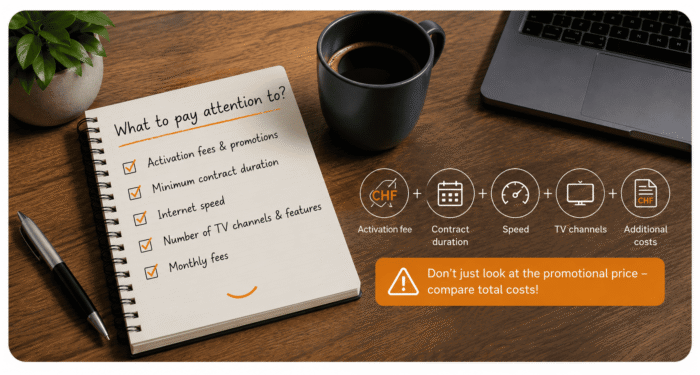
Some internet and TV offers appear particularly affordable at first glance. However, the advertised price does not always reflect the actual costs over the entire contract period. When comparing offers, you should therefore look more closely and not consider only the first month.
Promotional Price vs. Price After the Promotional Period
Many providers attract new customers with a low introductory price. For example, an internet and TV subscription may be significantly cheaper during the first few months and then automatically switch to the standard rate.
Especially with long-term contracts, the price after the promotional period is crucial. An offer that appears very cheap at first can become significantly more expensive after one year than a comparable package without a discount.
Therefore, always check:
- the regular monthly price after the promotion
- the duration of the discount period
- possible automatic tariff changes
- minimum contract periods such as 12 or 24 months
| Cost Item | What You Should Check |
| Promotional price | How long does the discount apply? |
| Regular price | How much does the subscription cost per month? |
| Contract duration | How long are you committed? |
| Additional options | Which services cost extra? |
A transparent comparison usually only reveals which offer is genuinely affordable after calculating the total costs.
Hidden Costs: Activation Fees, TV Box Rental and Minimum Contract Terms for Internet and TV Subscriptions
In addition to the monthly tariff, further costs may arise. Some providers charge a one-time activation fee for the connection or a monthly rental fee for the TV box.
Typical additional costs include:
- Activation or installation fees
- Monthly costs for additional TV boxes
- Fees for premium channels
- Costs for additional devices
- Long minimum contract periods
Families in particular should check whether multiple televisions can be used simultaneously or whether additional devices incur extra charges.
As a result, an internet and TV subscription that appears affordable can become more expensive over the entire contract period than a slightly more expensive tariff without additional fees.
Fibre, Cable or Mobile: Which Technology Powers Your Internet and Landline?
Every internet and TV subscription relies on a specific connection technology. This affects speed, stability, and, in some cases, the price.
The most common options in Switzerland are:
Fibre: Fibre-optic connections offer very high speeds and a stable connection. They are particularly suitable for households with intensive streaming, home working, or many devices.
Cable (Cable/HFC): Cable internet uses existing TV cable networks. It is available in many regions and also offers high speeds.
DSL: DSL uses the copper cables of the telephone network and is currently the most widely available technology.
| Technology | Advantages | Disadvantages |
| Fibre | Very fast, stable, ideal for many devices | Not available everywhere |
| Cable | Good speed, widely available | Performance may vary regionally; performance can drop when many users are connected |
| DSL | Fast, widely available | Performance decreases over long distances |
When choosing the right internet subscription, you should not focus solely on the maximum speed. The key factor is which technology is available at your address.
Internet and TV Bundle Comparison: The Most Important Providers in Switzerland
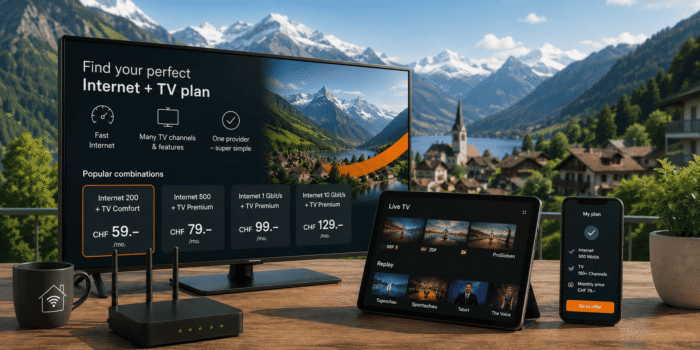
The market for internet and TV bundles in Switzerland is diverse. Swisscom, Salt and Sunrise operate their own networks. There are also providers such as yallo, Wingo, Migros Mobile, TalkTalk, Quickline and Sky that use existing networks.
The offers differ in price, speed, TV channels, and contract terms.
A good comparison therefore considers not only the lowest introductory price, but the overall performance of the package.
Swisscom, Salt, Wingo, Yallo & Migros Mobile at a Glance
The major providers offer different solutions for internet, TV and, in some cases, landline services. While some providers focus on premium packages with numerous features, others concentrate on affordable basic packages.
| Provider | Internet Service | TV Offering | Contract Model |
| Swisscom | Fast fibre internet, high-performance internet box, premium offer with extensive additional features | Comprehensive TV offering with many features | Premium segment, generally with a minimum contract period |
| Salt | High-speed fibre | Salt TV with a large selection of channels | Usually a combined contract |
| Wingo | Affordable internet and TV packages | Digital TV offering with app use | Flexible options |
| Yallo | Internet via cable, DSL or fibre depending on the region | TV packages with different tiers | Price-oriented offers |
| Migros Mobile | Primarily mobile services | Varies depending on the package | Focus on simple home subscriptions |
| Sky | Extensive TV offerings | Attractive packages for sports and shows | Various pricing models |
| Quickline | More than 200 HD channels, modern TV app | Live TV, Replay TV and recordings | Various packages |
When comparing offers, you should check which services you actually need. A premium package with many TV channels is only worthwhile if you regularly use these features.
Well-known providers such as Swisscom are also increasingly focusing on digital TV solutions, while more affordable brands often stand out with reduced packages. The best offer is therefore not automatically the most expensive or the cheapest, but the one that fits your everyday needs.
When Is a Combined Internet Subscription Worth It – and Who Is It For?
The right combination of internet and TV depends heavily on your usage habits. Small internet and TV packages may be completely sufficient for some households. Other households benefit from higher speeds and additional features in a bundle.
Singles & Couples: Is a Smaller Subscription Fast Enough?
For singles and couples, a smaller internet and TV subscription is often sufficient. Anyone who mainly browses the internet, occasionally watches films, and uses only a few devices rarely needs the highest speed.
An affordable internet connection combined with a basic TV package can often be the better choice. Streaming services such as Netflix or other services can also be added flexibly.
Otherwise, many users end up paying for channel packages or bandwidth that they hardly use.
Families & Heavy TV Viewers: When Is a Premium Package the Perfect Combination?
Families and households with several people often benefit more from a fast, high-quality internet connection. When multiple devices are online at the same time, children are streaming, adults are working from home, or gaming is a regular activity, performance becomes more important in order to avoid delays.
A fast connection with stable Wi-Fi and a larger TV offering can provide greater convenience in this situation.
Features such as replay, support for multiple TVs, and additional streaming options can also justify the higher price of a package from the internet provider.
What to Consider When Switching to a New Bundle
Switching to a new internet and TV subscription can be worthwhile if your current subscription has become too expensive or if you want more performance. Before signing up for a new offer, however, you should check a few practical points.
First, check the cancellation period of your existing contract. Some internet subscriptions automatically renew if you do not cancel them on time. You should also clarify whether you need to return your old internet box, modem, or TV box.
The timing of the switch is also important. Check when the new internet connection will be activated and whether installation by the provider is required. This helps you avoid interruptions to browsing, streaming, or telephone services.
When switching, it may also be worthwhile to reassess the speed you need. Perhaps you now require more bandwidth for working from home, streaming, or multiple devices — or perhaps you are currently paying for a level of performance you do not actually use.
Conclusion: How to Find the Cheapest Internet and TV Offer in Switzerland
The cheapest internet and TV subscription is not always the offer with the lowest introductory price. What matters is how much you pay over the entire contract period and which services are actually included.
Therefore, compare not only the monthly price, but also speed, TV features, additional costs, and contract terms. A smaller package may be perfectly sufficient for many households, while families or heavy users may benefit from a more powerful tariff — especially if you want the best entertainment experience.
With a careful comparison, you can find the offer that genuinely suits your everyday life and provides good long-term value for money.
Frequently Asked Questions
An internet and TV bundle combines an internet connection with a TV service. Typically, you receive a router or internet box for access as well as a TV box or TV app. Depending on the tariff, different channels, replay functions, recording options, and streaming features may be included.
That depends on your usage habits. A bundle can be cheaper because providers often offer discounts when you purchase several services together.
However, it is worth comparing the bundle with separate contracts. If, for example, you rarely watch TV, a cheaper internet subscription combined with a single streaming service may be more affordable than a large TV package.
When comparing offers, do not focus solely on the advertised price. The available technology, such as fibre, cable, or mobile, can also make a difference.
After a promotional offer ends, your contract normally continues at the regular price. This price can be significantly higher than the original promotional price.
You should therefore check before signing up how much the internet and TV subscription will cost after the promotion. Otherwise, an offer that appears affordable can become more expensive in the long term.
This depends on the provider. Some provide the TV box free of charge, while others charge a monthly rental fee or fees for additional devices.
If you want to use multiple televisions, you should check carefully whether additional boxes or features cost extra.
Yes, some providers offer flexible tariffs without long-term commitments. However, these are not always the cheapest options.
A longer contract period may, in return, offer better prices or additional services. The important thing is that the contract terms suit your individual situation.