Best Internet for Gamers in Switzerland: Speed, Ping & Choosing a Plan


You don’t necessarily need the fastest internet plan for good gaming. What matters most is a stable connection, low ping, and as little latency fluctuation as possible. Whether you play on a PC, use cloud gaming, or stream on Twitch at the same time, the quality of your connection can make a big difference. Of course, factors such as your device, system configuration, display resolution, storage drive, drivers, controller, and graphics card also play a role.
In this guide, you’ll learn which figures really matter for gaming, how much bandwidth you need, and which technologies are suited to your requirements.
We’ll also show you what gamers should look for when choosing an internet plan – from fibre to cable and 5G. This will help you find the right internet service for gaming in Switzerland and choose a plan based on speed, stability, and price.




What Makes an Internet Connection Good for Gaming?
A good internet connection for gaming isn’t just about high download speeds. Three values are particularly important for a smooth gaming experience:
- Ping
- Jitter
- Packet loss
Each factor matters. Together, they determine how quickly and reliably your inputs reach the game server.
Ping (Latency): The Most Important Figure for Gamers
Ping measures how long a data packet takes to travel between your device and the game server. The lower the value, the faster your inputs are processed. For online gaming, a ping below 20 ms is considered excellent.
Between 20 and 50 ms, the connection is generally good. At around 100 ms or more, delays can become clearly noticeable. In fast-paced multiplayer games in particular, just a few milliseconds can make a difference on screen.
That’s why you should consider not only your connection’s maximum speed, but also the distance to the server and the quality of the connection.
Jitter and Packet Loss
Jitter refers to fluctuations in ping. For example, a connection might average 20 ms but fluctuate between 10 and 50 ms. These variations can be more disruptive to gaming than a consistently slightly higher ping.
Packet loss is also a problem: if data packets are lost in transit, they have to be retransmitted or information goes missing. This can cause brief interruptions, so-called rubber-banding, delayed actions, or even disconnections. That’s why even a very fast connection can deliver a poor gaming experience if it is unstable.
Download and Upload Speeds
Download speed is especially relevant for large updates, game downloads, and several applications running at once. Online gaming itself requires comparatively little bandwidth. Upload speed becomes more important when you stream at the same time, use voice chat, or upload large amounts of data. On a PC used for streaming, audio, and gaming, several applications may transmit data simultaneously. Symmetrical fibre connections are particularly appealing here because download and upload speeds can be similarly high.
How Fast Does Your Internet Need to Be for Gaming?
The speed you need for gaming depends on how you use your connection: conventional online gaming usually requires well under 100 Mbps, while cloud gaming, streaming, or several gamers in one household need more headroom. The key is to ensure that bandwidth remains stable when other devices are active at the same time.
| Use | Recommended download speed | Recommended upload speed |
| Online gaming | from 25 Mbps | from 5 Mbps |
| Cloud gaming, e.g. GeForce NOW or Xbox Cloud Gaming | from 50 Mbps | from 10 Mbps |
| Streaming on Twitch/YouTube | from 50 Mbps | from 10–20 Mbps |
| Large game downloads | from 100 Mbps | from 10 Mbps |
| Household with multiple gamers | from 200 Mbps | from 20 Mbps |
These figures are guidelines, not a standard or technical minimum requirement for every individual game. For cloud services, latency is particularly important in addition to bandwidth. A high upload speed can also be useful for streaming, helping ensure that your stream isn’t affected by other network activity.
Fibre, Cable, DSL, or 5G: Which Internet Technology Is Best for Gaming?
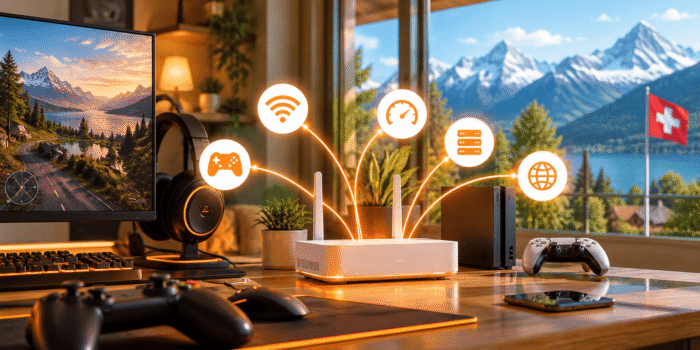
Which type of internet is suitable for gaming depends not only on the technology but also on availability at your address. Depending on your location, Switzerland offers fibre, cable, DSL/VDSL, as well as 4G and 5G solutions. Before signing up for a plan, check which connections are available where you live.
Fibre (FTTH)
Fibre is generally the most technically attractive option for demanding gaming. FTTH (Fibre to the Home) connections offer very high speeds, low latency, and often strong upload performance. Connections of up to 10 Gbps are available in many Swiss cities.
This technology is especially appealing for households where people game, stream, and transfer large files at the same time. Symmetrical connections can also provide very high upload speeds. FTTH is therefore an obvious choice for gamers who value stable connections and plenty of capacity.
Cable Internet (Coaxial)
Cable internet over a coaxial network can also deliver high download speeds and is generally suitable for online gaming. Compared with fibre, latency and upload speeds may be somewhat less attractive, depending on the plan. Available capacity in a particular network area can also have a greater impact during peak hours.
Cable is still a powerful solution for many households, especially when fibre isn’t available. The specific technical figures for the plan in question are what matter.
DSL / VDSL
DSL and VDSL are widely available and may be sufficient for casual gamers. However, speed depends heavily on the distance to the connection point and the local infrastructure. Upload capabilities are usually more limited than with modern fibre connections. If you only play online occasionally and don’t upload large amounts of data, VDSL can still be a practical option. For demanding gaming with streaming or multiple users, more powerful alternatives are often available.
5G and 4G Home Internet
5G and 4G internet can be an interesting alternative if no high-performance fixed-line connection is available where you live. Mobile solutions can provide additional options, particularly in rural areas. However, latency depends more heavily on signal quality, network congestion, and location than it does with a good fibre connection. 5G can work well for gaming, but ideally you should test it under real-world conditions before signing up. It can also be useful as a backup for a fixed-line connection.
Which Internet Plan Best Meets Gamers’ Needs?
For many gamers, a fibre plan with low latency, symmetrical speeds, and a public IPv4 address is a good choice. The option that actually makes sense for you depends on your location, hardware, and usage. In addition to price, compare the technical details and contract terms.
What Gamers Should Look for in a Plan for the Best Gaming Experience
When choosing a gaming plan, don’t focus only on the maximum download speed. In particular, check the following:
- Public IPv4 address / no CGNAT: This can matter for certain multiplayer games, hosting your own servers, or specific NAT requirements.
- Router with bridge mode: This allows you to use your own router or a powerful firewall if needed.
- Symmetrical upload speed: Particularly useful for streaming, large uploads, and multiple users.
- No throttling: Check whether speeds or usage are restricted after a certain data allowance.
- Contract term: Check the minimum term, cancellation notice period, and any fees that may apply when switching.
- Router quality: Modern devices with Wi-Fi 6 or Wi-Fi 7 can offer advantages when multiple devices are connected.
Your software and hardware matter too: a powerful PC with a suitably specified Intel Core processor, suitable laptops, good accessories, and a stable network card can make the most of your connection. However, they can’t replace a good internet service.
Swiss Internet Providers for Gamers at a Glance
The Swiss market offers a range of providers and technologies. Maximum available speeds depend on the specific connection, location, and plan. Features such as Wi-Fi, TV, telephony, and add-on options also vary by brand.
| Provider | Technology | Maximum speed | Feature for gamers |
| Swisscom | Fibre / DSL | Up to 10 Gbps* | Very high speeds and broad availability |
| Sunrise | Fibre / cable / DSL | Up to 10 Gbps* | Combination of different access technologies |
| Salt | Fibre | Up to 10 Gbps* | Very high speeds where FTTH is available |
| Quickline | Fibre / cable | Depends on connection | High speeds across different networks |
| Wingo | Fibre / DSL | Up to 10 Gbps* | Online-focused plans and flexible options |
Maximum speed depends on availability, infrastructure, and the current plan. Check the specific offers before signing up.
On alao.ch, you can compare current internet plans and compare offers by speed, technology, and price. This lets you see which options are available at your address.
Best Home Internet for Gaming: 6 Tips for a Low Ping
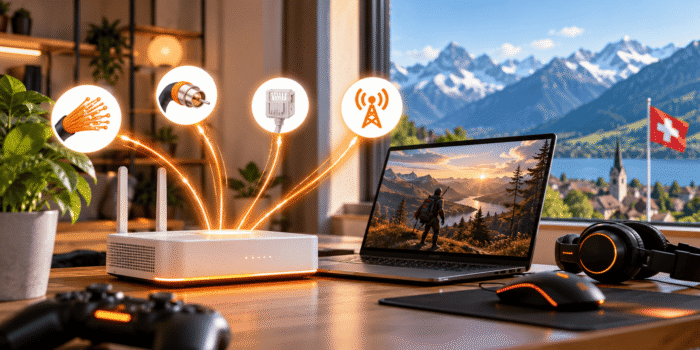
Even the best internet connection for gaming won’t help much if your home network slows it down. A few simple measures can improve latency and stability:
- Use an Ethernet cable instead of wireless: Connect your PC or console directly to the router via Ethernet wherever possible. This reduces potential wireless interference and connection fluctuations.
- Position your router correctly: Place the router in a central, unobstructed location. If Wi-Fi is unavoidable, Wi-Fi 6 or Wi-Fi 7 and a suitable router location can help.
- Enable QoS/gaming prioritisation: Some routers can prioritise gaming data over less important network activity.
- Stop background downloads: Pause large downloads, cloud synchronisation, or updates during important matches.
- Choose the nearest game server: A server that is geographically close can reduce latency. Some games select the server automatically.
- Run speed and ping tests: Regularly check download speed, upload speed, ping, and connection stability. This helps you spot changes sooner.
Internet for Gaming Cafés, Esports Teams, and Corporate Events
Gaming cafés, esports teams, and corporate events have higher requirements than a single household. Alongside high bandwidth, a stable connection, sufficient upload capacity, and reliable support are important. During tournaments, for example, people may be gaming, streaming, and transmitting audio at the same time, creating a much heavier network load. In these situations, a wired LAN connection is far superior to Wi-Fi.
For businesses, business plans with a Service Level Agreement (SLA), a static IP address, and dedicated support may be worth considering. An additional 5G connection can serve as a backup if the main connection fails. A suitable network architecture with a professional router, switches, and as many wired connections as possible is also important.
On the alao Business page, you can compare business offers and explore suitable solutions for your company. For larger gaming events, it is also worth checking available bandwidth and technical requirements well in advance.
Common Mistakes When Choosing Internet for Gaming
There are a few common mistakes people make when choosing an internet connection. For gaming in particular, looking only at the download speed figure isn’t enough.
- Focusing only on download speed: Extremely high bandwidth doesn’t guarantee a low ping.
- Ignoring ping: For fast online games, high latency can be much more disruptive than a lower download speed.
- Choosing an upload speed that’s too low: Streaming, cloud services, and multiple users can quickly saturate upload capacity.
- Using Wi-Fi only: Wireless connections can be affected by distance, walls, or other devices.
- Not checking availability at your address: Not every connection or technology is available everywhere.
Before signing up for a plan, check the technical specifications, availability, and your actual usage. This helps prevent a situation where your new plan looks fast on paper but doesn’t meet your needs.
Compare Internet Plans for Gamers Now—Free on alao.ch
Looking for internet for gaming with the right speed, technology, and price? On alao.ch, you can compare different Swiss internet plans and filter offers by important criteria. Check which speeds and technologies are available at your address, compare monthly costs, and choose the plan that suits your gaming routine. You can sign up online in just a few steps.
FAQ – Frequently Asked Questions About Internet for Gamers in Switzerland
A ping below 20 ms is excellent for online gaming. Between 20 and 50 ms, latency is generally good. At around 100 ms or more, delays can become clearly noticeable. It’s also important for ping to remain as stable as possible, with little jitter.
Yes. In most cases, 100 Mbps is easily enough for conventional online gaming. More bandwidth can still be useful if large updates are running at the same time, several people are gaming, cloud services are being used, or you’re streaming.
Fibre can offer advantages in latency, upload speed, and long-term capacity. However, cable internet can also be very suitable for gaming. The specific figures for the plan and the connection quality at your location are what matter.
Yes, 5G can work well for gaming. However, actual performance depends on signal strength, location, and mobile network congestion. As a result, ping and stability can fluctuate more than with a good fixed-line connection.
With CGNAT, multiple connections share a public IPv4 address. This restricts incoming connections from the internet. It can cause problems with certain multiplayer games, hosting your own servers, or specific NAT requirements. A public IPv4 address can be helpful in these situations.
Not necessarily. For Twitch, a sufficiently fast and stable upload connection is particularly important. If you’re gaming and streaming in high quality at the same time, make sure you have enough bandwidth to spare. A symmetrical fibre connection can be especially useful.